
Post#5: Founding Science
Introducing a metascience movement

I recommend this NotebookLM podcast to start:
Here’s a 15 minute guided reading:
Post#5: Founding Science
Introducing a metascience movement
1. Recap
This short recap is to help tie this fifth post in with the last four:
The first argued that we exist as value driven entities which ultimately seek to feel good rather than bad each moment, though in practice memory helps bond the instantaneous self with its past, and hope/worry helps bond it with potential future selves. The second delved deeper into this theme by demonstrating that self does not ultimately reside in the form of our bodies or even our thoughts, but rather the good to bad that we feel each moment. Next I demonstrated that computational functionalism stops one step short of full causality, and specifically because information can only exist as such by informing a causally appropriate substrate. Then last time I proposed an empirical test from which to prove whether or not a neurally produced electromagnetic field happens to be the substrate that processed brain information informs to reside as a given value driven entity in the end.
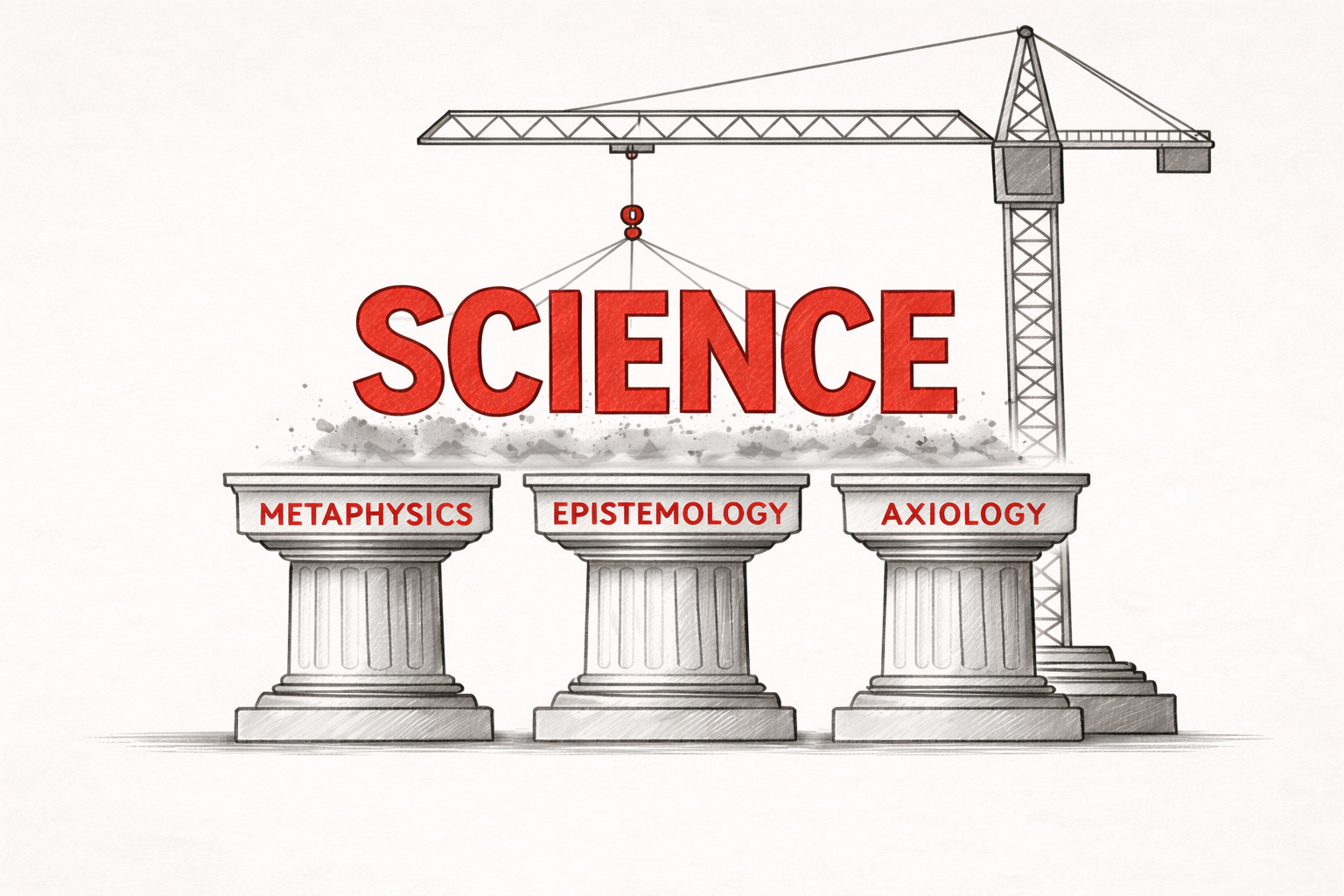
One theme here is that mental and behavioral forms of science are still in need of effective founding ideas from which to build. I’m going deeper now however to the founding of science as a whole, and specifically given that its function depends upon still speculative topics in philosophy. I’m referring to metaphysics (what exists), epistemology (how to understand), and axiology (the nature of value). The proposal is that a new specialization in philosophy must be developed which has the sole purpose of providing agreed upon principles from which to found science more effectively than past merely implicit rules so far. Then in my next three posts I’ll present a manifesto of my own for each branch. Let’s kick this off with some relevant history.
2. The birth of science from philosophy
For millennia in the western world there has been both a reason based approach to modeling the essentials of how things work, known as “philosophy”, as well as a faith based approach, known as “theology”. Furthermore in recent centuries the reason based form began to make large enough strides for its understandings to transform the human into an amazingly powerful creature. Thus what was traditionally known as “natural philosophy” became known as a separate domain called “science”.
One point of contention here is that philosophy can seem like a waste of time when it’s compared against the clear progress that’s occurred in science. Furthermore philosophers often charge such critics of committing a fallacy called “scientism”, or the unfalsifiable claim that enlightenment can only occur by means of science. Though I consider this particular charge against philosophy critics dubious, there are two reasons that I believe philosophy should always remain an important part of academia.
3. Why philosophy still matters
The apparently weaker attribute may be considered cultural or even artistic. This is to say that philosophy can be appreciated for the reasoning that’s done in it itself rather than for the usefulness of any resulting understandings. Many seem to enjoy how basic questions in the field have been considered for thousands of years and will presumably be considered for thousands more. If the process of doing philosophy itself happens to be valuable however then in this sense critics should be missing the point.
While some might shrug off arguments about “appreciating the journey rather than the destination”, the second attribute should be more difficult to dismiss in general. It’s essentially that philosophy is needed to house all reason based speculation that’s not appropriate for science. Here philosophy may be considered anything from “pre-science” to “beyond science” and so will even include “pseudoscience”. For an example of this, physics hasn’t always warranted a “science” classification as the term is used today, though was instead referred to as “natural philosophy”.
In this modern age where nearly everything is explored in at least some sense by means of science, what else should be left to make this transition? From what I can tell there’s just one basic topic left, though it also leaves a massive hole in the fabric of science. I’m referring to mind or consciousness. Because it’s not yet understood what our brains do for mind to result, modern neuroscience for example can only work around the edges of this void.
4. Metaphysics and epistemology should remain in philosophy, though axiology should eventually migrate to science
Whether or not mind is essentially the last element of philosophy still in need of transition, what would remain if science were to explore all that’s appropriate for it to? Would philosophy simply involve unanswerable questions to perhaps promote personal growth and social culture? Actually there should still be topics that concern the means of doing science itself. We should never have a science of metaphysics because in some sense metaphysics is required to do science itself rather than something to determine by means of science. Also there should never be a science of epistemology since in some sense an epistemological premise of how to figure things out is required in order to potentially figure anything out, or again something to begin with rather than to discover by means of science. Thus it would seem that each should be left under the domain of philosophy. My further point however is that science should function better by means of professionally accepted rules in these regards rather than to rely fully upon implicitly understood guidelines.
You might notice that I haven’t yet included axiology, and this is intentional. As a crucial element of mind I believe that the topic of value should eventually transition from philosophy to science. Notice that physicists don’t need to presume anything about value in order to do their modeling, and given that gravity and such do not function by means of what’s valuable to them. Though I’d love for this transition to begin even today, in practice I doubt academia itself will begin moving this way until after it becomes empirically determined what the brain does to create mind/value (such as create the correct parameters of electromagnetic field).
Many philosophers should dislike the thought of eventually losing axiology to science given that it’s been a basic aspect of philosophy for ages. Thus I’d expect critics to ask how I think science could empirically determine which sorts of behavior are the morally right kind as opposed to the morally wrong kind? I consider this to be a category error however — behavior itself should not be referred to as morally right/wrong. Instead morality should be said to exist in terms of what’s felt about behavior, and whether judging one’s own or someone else’s. Furthermore once the brain physics of mind/value does gain some clarity we should be able to reduce feelings like guilt and sympathy to objective brain physics which supports a psychology based science of morality. Of course philosophers could continue to explore a supposedly objective rightness to wrongness of behavior itself even then, though perhaps as a pseudoscience.
5. The proposal itself
Now that I’ve provided some relevant history and structure there’s the question of what exactly my proposal happens to be? I’d like a new specialization in philosophy to be developed which is exclusively tasked with providing professionally accepted founding principles to help science function better than in the past. I’m partial to calling this “metascience”, and so it would be explored by “metascientists”. Though this misleadingly implies a variety of science rather than philosophy, a strong precedent does exist for this name. “Metaphysics” is not the science of physics but rather addresses what comes before its study. So “metascience” would be a classification of philosophy that founds science in general.
One question I’ve been asked when I’ve mentioned the need for such a field is how might this add something different and valuable as opposed to the work that modern philosophers of science do? The key difference is that while philosophers of science have not had the central mission of developing explicit rules of metaphysics, epistemology, and axiology from which to found science, that specifically would be the purpose of this new community. And would I be pleased if existing philosophers of science were to expand this way and so eliminate the need for this new specialization? Yes that would be wonderful! They’ll have every opportunity to do so if they like as well. If they don’t however then a new community which has this sole purpose would need to be developed.
From discussions I’ve had with AI it would seem that my proposal is relatively original. Though there already is a movement called “metascience”, its goal is to improve existing science methodology rather than go deeper to develop explicit rather than implicit rules from which to better found science. The Logical Positivists from the 1920s and 1930s were mentioned as well. Apparently they focused on epistemology in the attempt to eliminate unfalsifiable claims, though the movement might have failed because their own claims were similarly unfalsifiable.
One question to ask here is how might science change by means of explicit rather than implicit rules of metaphysics, epistemology, and axiology? This should depend upon the specific principles that become adopted and so my coming three posts should display this in terms of my own vision. For now however the following is a quick taste of the simple rules that I’ll be arguing for in my next three posts:
For metaphysics I propose that standard science begin from the premise that causality never fails, and so explanations which involve such failure would instead be explored under a “causal plus” variety of science. For epistemology I essentially frame “the scientific method” as humanity’s exclusive means of figuring things out, as well as codify Occam’s nominalism and razor in these efforts. For axiology I posit that each moment of good/bad which is felt constitutes the exact value of existing as any defined individual or group subject at that point, which is to say an element of physics harnessed by evolution to drive the conscious form of function.
6. Metascience initially and beyond
Regardless of whether you like or dislike the metascience concept itself, I hope to hear from you in the comment section here as well as in the coming three posts. At the end of the next three however I’ll leave a working document that begins with the principle that I propose for that post. Then to participate anyone could either submit another principle that they think would work better than mine, or agree with a principle listed already. With one vote per person I’ll update each list from the provided comments. It should also be simple to change a given vote if new considerations alter anyone’s opinion. If no one proposes anything different from mine then that would be our proposal, and on the strength of you who agree. To resolve between different alternatives however I’ll paste the list with their vote totals into an AI for it to consolidate them into just one set of rules based upon the number of votes that each alternative option has received. I suppose it would be possible to have equally weighted contradicting proposals that shouldn’t provide much for us to hang our hats on. Or perhaps reconciling various options in words on the basis of weighted votes will not produce a sensible option for even AI to come up with. Yes but blatant problems should be obvious to us so it’s not like there should be true concerns about stolen elections. This is just an exploration and I suspect things will go fine, so let’s give this a try. Because we here should develop a platform from which to potentially found science in these three basic ways, we should also become the world’s first “practicing metascientists”!
Though the conclusions we reach shouldn’t have much political weight or legitimacy, I plan this merely as a demonstration of the concept itself. Even today it should be possible for respected professionals to provide explicit rules of science that they’re able to endorse. Thus willing participants who are perceived and/or advertised to be experts in metaphysics, epistemology, and axiology, ought to provide an associated level of political weight and legitimacy to a resulting set of rules.
Hopefully the concept here will spread. I’ll of course link back to these four posts when I notice relevant material at the blogs of others, and both to advertise my own such ideas as well as the concept of metascience itself. Once my four posts are complete I’ll see if I can get any interest from the metascience project that’s already working to improve science through existing implicitly understood rules. Hopefully some of these professionals will at least provide opinions on reasonable epistemological principles, though I’d appreciate metaphysical and even axiological rules from them as well. For now this is simply exploratory though I’ll be interested to know what rules might be chosen that are different from mine. I also plan to see if Sabine Hossenfelder (the German physicist and now popular YouTuber) would like to participate given her strong opposition to modern physicists being swayed by theory that’s not even conceivably testable.
The gold standard should be for universities to offer specific metascience courses and philosophy degrees with this emphasis. Long before that happens however I’d expect there to be an effective set of known explicit rules that scientists use to structure their fields in these three ways, and supported by an informal but respectable group of metascientists. In the early years there shouldn’t need to be anything institutionally set up for proponents to gain reasonable influence. Among academics who support the concept of metascience it might even become standard to publicly display one’s preferred rules of metaphysics, epistemology, and axiology so that their perspectives can easily go into the calculations of any given metascience manifesto compilation.
7. Rule variability may not be a problem
Also I should say that the basic subject matter here itself suggests to me that there shouldn’t be a wide range of opinions to reconcile. If we were asking how to best rehabilitate criminals, deal with climate change, or any other high level question, the wide scope of such topics should tend to elicit a wide range of even expert opinions. So reducing them to just one could be challenging. The questions presented here however ought to elicit relatively narrow answers given that what’s being asked is so basic.
As I see it science only needs to consider one thing in terms of metaphysics — does systemic causality hold or not? Regardless of whether future experts end up agreeing with my own position that magical speculation must be banned from science, I’ll be very surprised if they find something other than this to argue about metaphysically. Regarding epistemology, observe that we already have a tried and true scientific method where models require relevant empirical evidence to gain credence. Beyond perhaps providing supporting ideas for this (as I do), I doubt any epistemological statement which is fundamental enough to plausibly found science in this way, will bear much possibility to wander very far. I consider axiology most important given that I think the reason psychology has developed little in the way of effective general modeling so far, is largely because it hasn’t yet been able to fully accept the value premise that’s permitted economists to develop a wide range of effective models. But when a given metascientist is tasked with providing a core reduction for that which constitutes the value of existing in itself (rather than our various moral notions and whatnot down the line), again there shouldn’t be much room for a wide range of opinions to potentially reconcile.
8. Expected status quo resistance
The true challenge here should be the negativity of those who would feel threatened by academia expanding in this way. I wouldn’t expect moral realists, for example, to figure out a basic axiological premise that supports their position. Thus instead of directly competing they should fight the entire concept of metascience as inherently flawed. Indeed many philosophers should consider the emergence of metascience threatening simply given that they shouldn’t have structured their careers on the basis of such emergence. Because these new metascientists would effectively be providing scientists with agreed upon solutions, would the public begin to consider them superior to the traditional sort which famously fail to provide such answers? Perhaps. I’m pretty sure that status quo resistance will provide the central headwind fighting the emergence of the philosophy specialists that I propose. But controversy and all, to me the entire thing sounds like great fun!
Eric, we've discussed your proposals along these lines many times. I'll only point out a few things here.
The logical positivist standard was verification, which it was eventually pointed out, is itself unverifiable. That standard is too strict,. It would require throwing out too much productive science. Falsifiability is actually a weaker standard introduced by Karl Popper, who was a critic of the logical positivists. Popper argued that while we can never verify a scientific theory, we can, at least in principle, falsify them, if they are indeed false.
Of course, falsifiability has its own issues, as many have pointed out. The failure of Newtonian mechanics to predict Uranus' orbit led to the discovery of Neptune. But the failure to predict Mercury's eventually falsified the theory. Although it wasn't really accepted until there was an alternate theory: general relativity.
My other point is one I've made before, but concerns your causality standard. Causation, in the sense of an asymmetry between cause and effect, is not fundamental. It emerges with the second law of thermodynamics and the direction of entropy increasing. Without that, what we have are symmetric structural relations across time and space, which would put us in structural realism territory. And while my expectation is that these are ultimately deterministic, I hold that metaphysical assumption loosely, always prepared to bracket it if necessary to accept a successful scientific theory.
Finally, along the lines of one of my recent posts, I'm leery of anything being declared fundamental or axiomatic. Historically, it seems like everything declared fundamental by someone eventually turns out to be emergent from something else. For instance, atoms were supposed to be the fundamental building blocks of matter, but turned out to be composed of electrons, protons, and sometimes neutrons. And protons and neutrons themselves turned out to be composed of quarks. It seems unwise to be too comfortable that we've hit bedrock with our current understandings.
Hi Eric, I find your proposal to be interesting and relevant to what I'm also pursuing. I'm a middle school science teacher in Australia and I have been wondering whether such an explicit set of philosophical principles could better serve science education. Through my personal philosophical exploration I have shifted my attention from epistemology to ethics since I deemed it would be more beneficial for me to focus more on being a good teacher rather than an anti-scientism-ist (although they are related issues). I mention ethics because it seems as though the reason you're pursuing this project is rooted in axiology, or values of existing, as you put it, with a focus on "feelings" of good to bad, and not so much on good or bad behaviour. As a school teacher it's easy to get tied up on behaviours! So I find your comment on axiology becoming science or psychology to be interesting - I interpret this as a possibility to elevate certain metaphysics in the Korean Confucian tradition I'm familiar with as they talk about attention and care as ways to promote virtue ethics. I look forward to your upcoming posts! Cheers