
Post#6: Axiologically Founding Science
(Part 1 of 2)

Introduction — psychology as pre-atomic chemistry
I’ve long theorized that each and every one of us, from the most despicable sadistic bastards to the most kind and loving humanitarians, ultimately choose to do what we do on the basis of a personal desire to feel good rather than bad. This is to say that even given our favorable to unfavorable perceptions of various people, in the end we all function as self interested products of our circumstances. This contrasts with the “altruism” premise that authority figures seemed to push me towards as a kid. Later I realized that only the behavioral science of economics was effectively founded upon the premise that value exists as feeling good rather than bad, though disguised by means of a “money” representation. Because economists have developed a vast collection of successful models while behavioral sciences which lack a money proxy have not, might the still struggling fields make similar gains by formally adopting the same effective value premise that economists use? That specifically is my proposal.
Of course no modern psychologist denies that human motivation exists at least in part as the desire to feel good rather than bad. Apparently the consensus however is that this is just one element of a far more complex and still uncertain question. Aren’t we ultimately more than just base pleasure seekers? The challenge may be that because personally feeling good is indeed what constitutes the value of existing, we thus tend to downplay our own value based interests to potentially gain the favors of others in a way that may ironically also help advance our value based interests. And note that this needn’t occur exclusively by means of deceitful salesmanship. I’m also speaking of a broad social theme where the interests of apparently selfless people naturally tend to be encouraged and praised while the interests of apparently selfish people naturally tend to be hated and vilified. Perhaps the disguise of money has permitted economics to adopt an effective value premise, though fields without such a proxy have been too vulnerable to social pressure to do the same?
Consider how the atomic model was required in order for chemistry to become an advanced science. Doesn’t psychology today seem about like pre-atomic chemistry, or highly disjointed and speculative? And conversely aren’t modern economists able to model economic function somewhat like modern meteorologists are able to model coming weather systems? I believe that all behavioral forms of science need to become founded upon the same value premise that economists effectively use, which is to say that feeling good/bad constitutes the essential motivation which drives the conscious form of function. This might be no less foundational than chemistry’s atomic model.
Since the 1950 Turing test it’s become somewhat popular to believe that psychology is discoverable “top down”. The theme is that if computers can effectively fool us into believing that they’re human in various ways, then this must be because they’re also effectively “conscious” in those ways. My own speculation instead functions “bottom up”. Here I begin from the premise that there is a causal element of physics which constitutes the value of existing as anything at all. I then use this premise to propose how evolution should thus have manipulated this physics to create the conscious form of function that so vexes humanity. Next I provide a graphical representation of my associated dual computers model of brain function. In it the brain may be considered a relatively standard energy driven form of computer, though consciousness instead resides as a value driven form that the brain uses to better deal with more “open” circumstances.
This post begins the second in a series of four discussions where I argue that a new community within the philosophy of science needs to be created which provides various communally accepted principles of metaphysics, epistemology, and axiology from which to better found the function of science in general. I propose that these professionals be referred to as “metascientists”. Though I originally planned this second discussion to address my own stance on what exists (metaphysics), instead I’m beginning with the traditionally most vexing topic of all, or axiology. What might ultimately be said to constitute “value”, or the good to bad of existing in itself?
A scenario by which a proposed value physics evolved to create the conscious form of function
Notice that during early stages of our planet there shouldn’t have been either “life” (a term that doesn’t need exact specification here) nor anything to speak of that’s driven by means of “value” (which I consider usefully defined as “feeling good/bad”). Instead there should have been more basic sorts of physics which would eventually be used by evolution to create both life as well as existence that can feel good/bad. Two synonyms of value driven forms of existence would be the “sentient” as well as “conscious” sort.
Life of course emerged once the conditions here were sufficiently conducive. Value based existence should not yet have existed however. This is to say that nothing should have yet felt good or bad for early life forms, and similarly to how we presume existing doesn’t feel good/bad for modern plants and microorganisms.
(Auxiliary note: A value void here is disputed by both panpsychists and those who tend to consider life to be intrinsically valuable. So if they like such advocates could provide competing scenarios.)
Further life forms evolved central information processors that accept input information and algorithmically process it for output function, commonly known as “brains”. This should have essentially taken life to a valueless “robot” stage.
As the environments of evolution’s biological robots changed from more “closed” circumstances (like the game of Chess for example) to more “open” circumstances (like the game of Football), notice that to productively cope there should have been the need for perhaps exponentially expanding algorithmic instruction. If that’s the case then it should have been difficult for algorithms alone to keep up with more open environmental demands.
(Auxiliary note: And why believe that algorithms alone would be insufficient to effectively traverse from “closed” to “open”? This is merely what seems like the most sensible gap to me. Is there a better one? Some talk about the massive “learned” complexity associated with effective Chess algorithms, as well as how simple algorithms can sometimes be effective for far more than what they were intended to address. So it could be that I’m flat wrong about algorithm instruction alone being defeated by “openness”. Whatever failed however, apparently something did. Otherwise the algorithms of “philosophical zombies” could have evolved right along with us (which I mean in the sense of actual evolved beings able to survive with human sorts of abilities, though with an existence that feels no more good/bad than we presume for trees). If “open” does not sufficiently represent where standard algorithms failed then something else must. I provide this possible impediment simply for completeness, though others ought to support my proposal just as well. Perhaps algorithms alone expend prohibitively greater amounts of energy? That would work too. And perhaps exponential expansion of algorithms would not be required to effectively deal with whatever the issue happens to be, though I’m currently trying to address the existence of feeling good/bad itself since clearly this trait does exist in advanced forms of life.)
Secondly consider the emergence in these biological robots of an initially epiphenomenal or functionless entity that in some sense experiences its existence in a value based capacity. This is to say something that feels good/bad when the correct physics based conditions mandate such experience. Thus in an extremely basic and functionless sense, this would be a “consciousness”. And even though not yet empirically determined, imagine this in the form of a neurally produced electromagnetic field. Furthermore the reason we should presume no function here is because that’s how evolution works in general — it takes certain traits that initially had little to no adaptive function, and over various iterations of success and failure it sometimes makes them functional.
(Auxiliary note: Computational functionalists dispute the need for “value physics” given their position that any computer which does the correct sort of algorithmic processing will effectively “see”, “hear”, “think”, and ultimately harbor an existence which feels good/bad. They believe that code in various forms can potentially be processed to create a value bearing entity as I’m defining the term, and so a physics of value does not exist, but rather a programming of it. My post #3 however argues that in order for their premise to be true, there’d also be a need for magic. This is because processed brain information will need to inform something causally appropriate which itself exists as a given instance of value. Empirical science should eventually resolve our disagreement.)
I’m proposing that an extremely basic, initially epiphenomenal value physics emerged under certain primitive nervous systems. Then because it should have been difficult for algorithms alone to effectively deal with more open circumstances that may thus have needed exponential expansion, these dynamics incited the evolution of functional consciousness in general. Essentially at times the value experiencer would be given a choice about what the organism might do given various causal effects that it could have. Initially we shouldn’t expect that it would have done anything particularly adaptive, though it still would have had a desire to do things that make it feel better rather than worse, since that specifically is what “value physics” is postulated to be. So theoretically certain iterations did evolve the ability to make operational choices regarding organism function, and even succeeded well enough to further evolve into a second variety of function that may better address more open circumstances (or whatever it is that algorithm alone instruction did not address quite as well). I’m referring to “teleology” here, and where such purposeful function ultimately reduces to the physics of feeling good rather than bad.
Observe that even if early forms of life were to have eyes, an associated consciousness need not have been provided with a sense of vision. Early eyes should have instead informed brain algorithms essentially like camera information informs the robots that we build. Initial consciousness merely needed to be functional enough to help pass genes along somewhat better than otherwise. Only with success would such organisms progressively be given sense information, like vision, hearing, smell, touch, and so on.
I’ve just spoken of “true teleology”, and where the associated purpose resides as feeling good/bad. It’s a proposed physics of value regarding anything that exists, and indeed, I suspect this resides in certain parameters of electromagnetic field. For illustration purposes however I’ll now present a brief anthropomorphism of evolution in this regard, or “false teleology”. So here evolution might effectively “tell us” something like this:
“Because more open environments mandate that I can’t sufficiently provide exponentially greater algorithmic instruction, I also punish and reward a value driven experiencer on the basis of various conditions, such as to make it feel “pain”, “joy”, “hunger” and so on. This provides incentive for it to teleologically think about what its interests happen to be. Thus given its senses and memories it constructs scenarios about what might make it feel better rather than worse. Then on the basis of what it thinks about I run associated algorithms that effectively give that experiencer a sense of agency, such as the illusion that it rather than my algorithms operate various organism muscles.”
This is my dual computers model of brain function where the brain may effectively be considered a relatively standard energy driven form of computer that’s entirely non-conscious, though it also implements a different sort of computer that’s instead value driven, or the consciousness that each of us ultimately happen to be. Essentially the brain accepts input information from around the body and algorithmically processes it for output function, such as to effectively operate heart muscles. But beyond the non-conscious there’s also a variety of brain output that exists as input to an instead value driven auxiliary form of computer. Given its physics based drive to feel good rather than bad, this phenomenal experiencer is incited to think about its circumstances in order to potentially figure out how to feel better rather than worse. Theoretically some of its decisions then go on to have associated effects, such as to operate relevant muscles or even to reside as memory to potentially use later.
In my first post I postulated that each of us exist as instantaneous experiencers that tend to be joined with our pasts by means of memory, as well as the future by means of hopes and worries. In my second post I presented value as a summation of the good minus bad that any specific individual or group of individuals experience over a specific period of time. Now in this sixth post I’m going deeper to theorize why evolution used a value driven entity, or consciousness, to help algorithm based brain function more effectively given the challenges of more open circumstances. The proposal is that a purpose based form of function serendipitously emerged, or true teleology, to help more directly instruct brain algorithms. Here I propose that an initially epiphenomenal value-bearing physics associated with the brain was progressively recruited by evolution until it became the functional consciousness that each of us now happen to be.
My dual computers model of brain function
The graph below reduces the nervous system to a relatively standard energy driven form of computer that accepts input information from around the body and processes it algorithmically for output function. Furthermore one variety of its output resides as a very different kind of computer that’s value rather than energy driven. This value physics which evolution is proposed to have manipulated to create the evolved conscious form of function, is theorized as a neurally produced electromagnetic field (also denoted here as “EMF” as well as “EM field”). The proposition is that this feeds back to the nervous system for full looping operation.
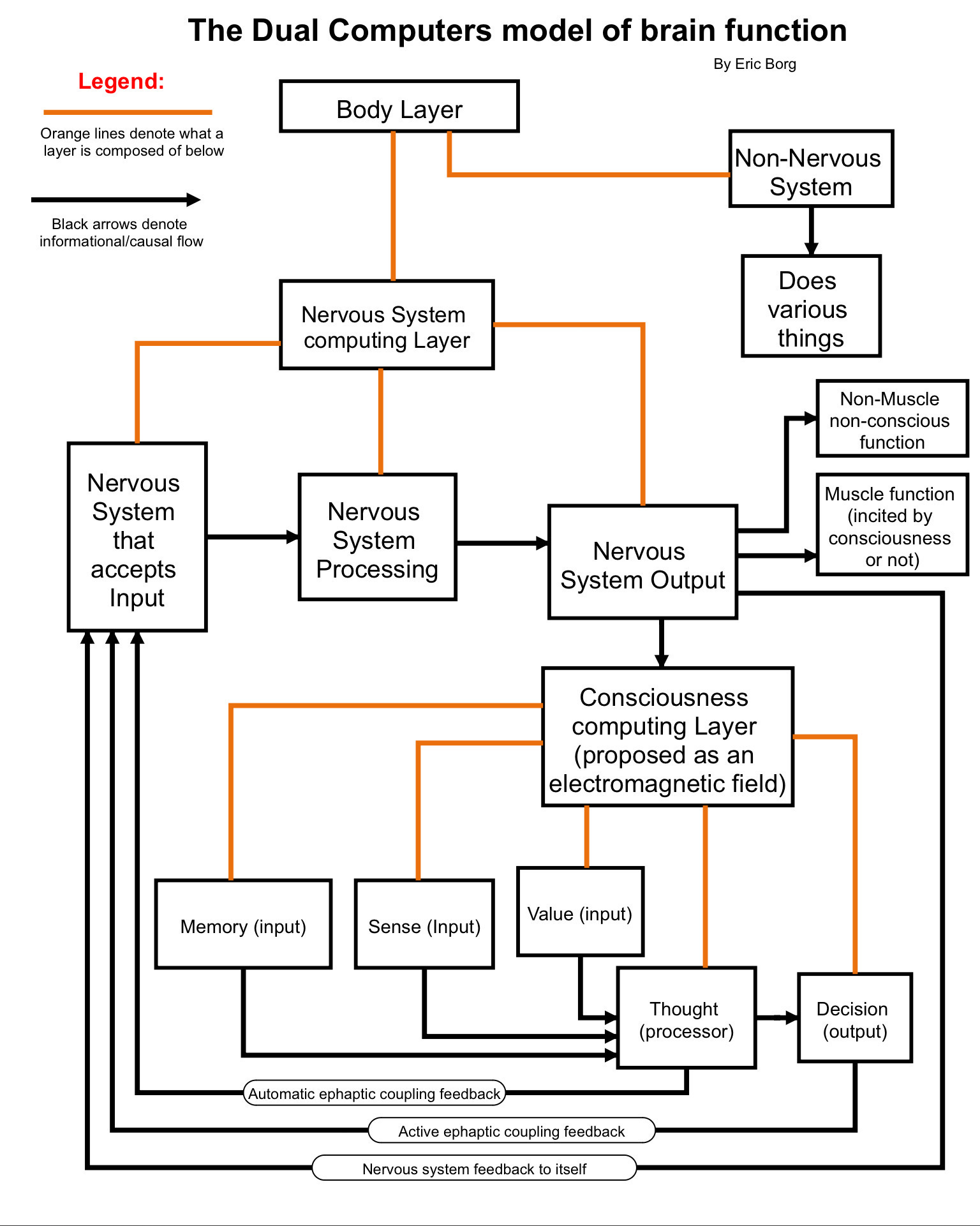
The orange lines reference what a given layer is composed of below. The top layer is “Body”, then “Nervous System” elements of body, then “Consciousness” elements of nervous system. Notice that the body layer is composed of both nervous system and non-nervous system, and so by definition all possible function is addressed here. Furthermore black arrowed lines address a directional passing of information to causally appropriate instruments. For example the non-nervous system with black arrowed lines to a box entitled “Does various things” references elements of body function beyond the nervous system that aren’t mentioned here. I should also say that these sorts of reductions falsely suggest something more than potentially useful ideas. Rather than ontological discoverables they denote epistemic fictions, as in the case of nominal constructions in general.
We see from its orange lines that the nervous system computing layer is represented by a box associated with input, processing, and output components. I consider all computers to function by means of these three basic features, and certainly the nervous system that tends to culminate in a “brain”. Also note that the body will inform the nervous system in ways that aren’t specified here. After processing comes output. The emerging arrows to the right feed non-muscle function, muscle function, and also there’s an arrow that recirculates back to run through such operations again. They cover the vast majority of what the nervous system does, and all by means of biological robotics. Most interesting here however is the arrow that drops down below to the consciousness layer of computing, and theoretically this is entirely in the form of an electromagnetic field that neurons produce when they fire with the proper sorts of synchrony. Whether EMF or not, I make three distinctions regarding this form of computer’s inputs, one regarding its processing, and two regarding its output.
Let’s begin at the left with the memory input component to consciousness. When we remember someone’s name for example, theoretically this resides as an associated electromagnetic field produced by the correct sort of synchronous neural firing. I won’t go through the many types of memory that psychologists identify, though several of them do not apply here since they’re associated with automatic body function. This box is instead meant for consciousness EMF that’s currently being remembered, such as the day of the week. As I understand it memory is often associated with the formation and strengthening of synaptic connections across networks of neurons, with certain brain regions, such as the hippocampus, playing especially important roles in encoding and consolidating new memories.
Another provided variety of conscious input is “sense”, or conscious forms of input information to potentially think about, such as vision, hearing, touch, and so on. And though there may be value components to standard conceptions of senses, such as how we like/dislike the taste of various foods, here I’m referencing senses in an exclusively informational rather than value based capacity. Value is instead addressed in the next box. So here I’m not referring to the painfulness of an injury for example, though rather just an informational component like identifying an affected body part. Or it’s not the good to bad feelings that can emerge by seeing something, but rather an ability to identify various seen objects.
Value is the last input form of consciousness that I’m presenting, and proposed specifically as feeling good rather than bad. In a functional sense I consider this to be the most basic element of consciousness, and even equate it with the whole as the defining trait. Thus I propose that a full value void, or perfect apathy, should effectively halt consciousness somewhat like a loss of electricity effectively halts the function of a standard computer. The premise is that consciousness without value would lack its defining element and so there’d be none.
Imagine seeing something comprehensible like a friend or even a generic landscape, though also feeling nothing good/bad whatsoever regarding your own existence. This is to say perfect apathy or personal irrelevance regarding what you see and all else. In that case I’m proposing that nothing would thus be “seen” even if all other conditions were met, and indeed, no other varieties of consciousness would exist either. It’s essentially like a standard computer without electricity thus has no capacity to compute. Or in an opposite case consider scientists creating something that feels horrible pain given such physics, though nothing more than that — just the suffering feeling. I’m analogizing this with a battery that has no circuit to run its electricity through — a potential motivation that has nothing to actually motivate. So if value drives the conscious form of function as I propose, then with absolutely no value we should expect that no consciousness will exist either.
The three black arrows from these input boxes inform thought, or what processes memory, sense, and value input. And indeed, this processor may think about past thought by means of memory. Given our highly linguistic nature thought is sometimes referred to as “the words in our heads”, though that’s just a standard human bias. The proposal here is that thought interprets inputs in order to construct scenarios about how things are so that reasonable responses might be made given the ultimate goal of feeling better rather than worse from moment to moment.
Regarding the output of thought, as displayed in the diagram I handle this in two ways that ultimately feed back to the nervous system by means of “ephaptic coupling”. So let’s first consider what’s meant by this. Essentially neural firing doesn’t just create the EM field that’s theorized to reside as consciousness, but the energies of the field can also have amplifying to inhibitory effects on the firing of affected neurons. It’s currently somewhat speculative in neuroscience how much this field functions mainly as a waste byproduct of neural firing with little functional uses, or rather the field is used heavily for still unknown purposes. But it is known that the EM field tends to help synchronize neural firing, so that could be important should the higher EMF energies here exist as consciousness. In any case such a consciousness would need to “talk back to the brain”, and ephaptic coupling is the proposed mechanism from which it does this.
One of the two black arrowed lines emerging from the thought processor goes to a box labeled “Decision”. I mean this to address actively derived decisions associated with thinking. For example if you decide to snap your fingers, theoretically the EMF of this thought ephaptically couples with the correct motor neurons that cause your finger muscles to get this done. So in the diagram this thought feeds back to the nervous system for processing in the attempt to do what was decided. Or perhaps you decide something to remember in general, like how to open the lid for a fancy new trash can. If you actively decide something to remember, theoretically this thought ephaptically couples with neural function that may help you remember this in appropriate situations. In any case I mean this output of thought to reference agency based function, and whether directly inciting certain muscle function at that time, or as something to potentially remember later.
The other black arrowed line emerging from the thought processor is referred to as “automatic ephaptic coupling feedback”, and as the name suggests it’s about thought affecting the nervous system automatically rather than through agent based decision. I sometimes also call this “the learned line” because conscious function often transfers over to non-conscious function given sufficient conscious practice. A classic example is how conscious practice driving a car can help this sort of function occur by means of non-conscious operations. In full however I mean this line to reference all situations where consciousness feeds back to incite brain function without explicit agency based “decision”. A given scent might automatically incite the memory of a place for example. So here the EMF of having this scent ephaptically couples with certain neurons ultimately causing them to fire with the correct sort of synchrony which provides the EMF memory itself. In that case no formal “thought” about this is even required. Or perhaps someone tells you their name. Any value based significance that you might have for this person should impact how much you think about this and so strengthen/build such a neural pathway. If you don’t consciously attempt to remember their name however, but do anyway, then this “automatic” line might provide the best assessment. When you later need this memory a causal neural path might exist to create an associated EMF consciousness, perhaps “Cheryl”.
Conclusion
I began this discussion by observing that neither life nor value should have existed on our planet originally, though valueless life should indeed have emerged once the conditions were right. I went on with the workings of consciousness as a product of the nervous system and body by means of a graphically represented model. Here the brain essentially functions as a relatively standard energy driven form of computer, though this should have been problematic for more “open” circumstances (more like Football than Chess). To get around this problem theoretically evolution used a physics based element of causality that resides as value, which is to say, something that feels good/bad. Theoretically evolution manipulated this sort of physics to create the conscious form of function. In my dual computers model the nervous system is an element of the body that functions as a relatively standard computer with input, processing, and output function. One of its outputs however is an electromagnetic field that itself resides as value driven consciousness. Consciousness is presented as memory, sense, and value forms of input to a thought processor that interprets them and constructs scenarios about what to do to promote its value based interests, and specifically given that this field is able to interact with the brain by means of ephaptic coupling.
If the simple model proposed here is essentially correct one might ask, shouldn’t this already have been figured out by now? Though that is a legitimate concern, in my currently planned part 2 of this axiology discussion I will make a case that long standing moral and cultural assumptions may have influenced the kinds of questions scientists have tended to ask about consciousness. And indeed, it could be that this is why philosophers at least since the rise of Christianity have largely neglected the question of what constitutes the value of existing to instead almost exclusively focus on how to judge the supposed rightness to wrongness of what people do. To potentially help rectify each of these circumstances, in part 2 I will reduce the moral form of creature back to two value based components of psychology.
For now however, what do you think? Might more “open” environments have challenged evolution’s biological robots enough for an initially epiphenomenal value physics to evolve into the conscious form of function in general? Or maybe there’s a better reason for consciousness to have evolved? And what do you think about my “dual computers” model where the brain is essentially a relatively standard energy driven computer, though one of its outputs is to create a value driven form, or true teleology where purpose exists as the drive to feel good rather than bad? I’d love to hear your thoughts!
Rather than get deep into the weeds. I think there is a missing point early in your essay. How exactly will your argument lead to a better foundation for the function of science in general? I think you need to first, explain that purpose and, second, justify that purpose. You state early on “…a new community within the philosophy of science needs to be created which provides various communally accepted principles of metaphysics, epistemology, and axiology from which to better found the function of science in general.” Simple question: Why? Why is this needed? What is the problem? From what I can see science seems to be doing OK.
This is great, Eric. The evolutionary frame is, IMO, key. (I don't know about the electromagnetic field, but I have no good theory. Just not "quantum"! :-)
Have you read / written about Damasio's The Feeling of What Happens?